


On 19 May 2026, at Hotel Solun in Skopje, the workshop “Implementation of the Institutional Development Plan (IDP)” was held with representatives of key institutions involved in flood management.
The workshop, as part of Activity 2, was held with the aim of fostering a structured and participatory discussion among relevant institutions and stakeholders to strengthen inter-institutional coordination and clarification of institutional mandates and responsibilities, to improve understanding of the interdependencies between legislative, technical, institutional and operational activities, and to foster ownership and active participation from all institutions.
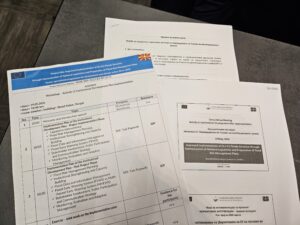
The expert Toni Popovski presented the IDP, that outlines a comprehensive roadmap for aligning North Macedonia’s flood risk management systems with the EU Floods Directive (2007/60/EC), in anticipation of full EU membership and increasing climate resilience.
The plan encompasses a comprehensive approach to:
- Institutional strengthening by enhancing the organisational structures, human capacities, and inter-institutional coordination mechanisms necessary for effective flood risk management;
- Legal harmonisation through the alignment of national legislation with the requirements of the EU Floods Directive and broader EU water acquis, ensuring clear mandates and compliance mechanisms;
- Public engagement by fostering inclusive stakeholder participation, raising awareness of flood risks, and empowering local communities to take part in risk reduction planning; and
- Data management improvements through the development of interoperable, transparent, and accessible information systems at both national and municipal levels, enabling evidence-based decision-making, timely communication of flood hazards and risks, and development of efficient and effective early warning system.
The Plan adheres to the following core principles essential for effective and sustainable flood risk management:
- it emphasizes inter-institutional cooperation by fostering structured coordination among national institutions, regional bodies, and local governments to ensure that flood risk assessments, planning, and response measures are coherent, integrated, and mutually reinforcing;
- it promotes transparency by ensuring that data, decisions, and planning processes related to flood risks are publicly accessible and clearly communicated, thereby enhancing accountability and trust among institutions and the public;
- it supports science-based planning by grounding all flood hazard assessments, risk mapping, and mitigation strategies in the best available hydrological, climatological, and geospatial data, and by adopting EU compatible methodologies and tools;
- it encourages public participation by actively involving communities, civil society organizations, and other stakeholders in the preparation and implementation of flood risk management plans, recognizing the value of local knowledge and the importance of socially inclusive decision-making; and
- it is committed to resilience building by promoting long-term, adaptive measures such as nature-based solutions, risk-informed land use planning, and early warning systems, that reduce vulnerabilities, enhance adaptive capacity, and prepare society to better withstand and recover from flood-related events.
The IDP is structured around ten key components, beginning with a clear mapping of institutional roles and the establishment of coordination mechanisms that will ensure alignment across ministries, other national institutions and agencies, municipalities, and other stakeholders.
Recognising the current gaps in organizational resources and capacity, the plan outlines targeted measures to build institutional competencies through training, recruitment, and technical support. It also addresses the urgent need for a robust legal and regulatory environment that harmonises national legislation with the EU acquis, enabling the consistent application of flood risk policies and enforcement across all levels of government.
Equally important are the provisions for enhanced data management and public access to flood related information. The plan envisions the development of a centralised national flood risk information system, improved data sharing protocols, and transparent communication tools to ensure that both institutions and citizens can make informed decisions. The plan also places strong emphasis on inclusive public engagement, ensuring that citizens, civil society, and vulnerable groups are not only informed but actively involved in flood risk planning and preparedness.
Monitoring and evaluation mechanisms are integrated throughout the plan to track progress, ensure accountability, and allow for adaptive management. A multi-year implementation roadmap, aligned with EU accession goals and national development priorities, provides clear milestones and responsibilities. Ultimately, the IDP represents a strategic investment in institutional transformation, risk governance, and societal resilience, laying the foundation for a safer and more climate prepared North Macedonia.
The project “Improved Implementation of the EU Floods Directive through Harmonization of National Legislation and Preparation of Flood Risk Management Plans” is supported by the European Union and co-financed from the budget of the Republic of North Macedonia, for the final beneficiary Ministry of Environment and Spatial Planning.